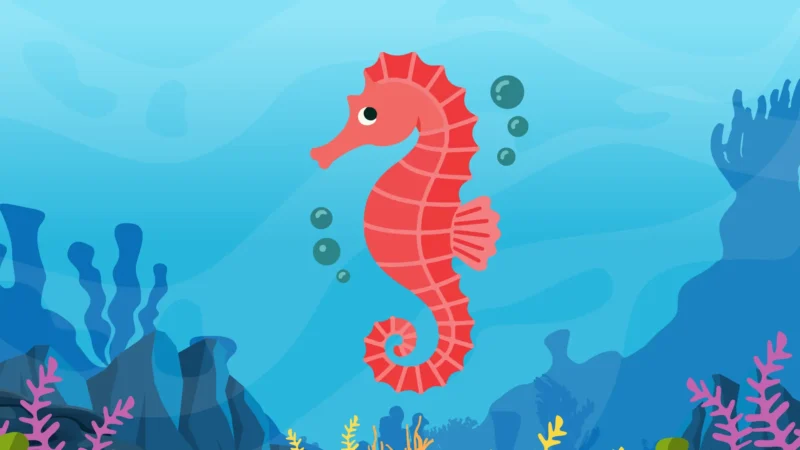
On Laugh Again we sometimes talk about the awesome critters God has designed, including a male that gives birth? Isn’t that a great idea, ladies? I’ll tell you which critter it is, but first, if you were building an underwater boat, would you craft it out of wood? Likely not. But Cornelis Drebbel did. In 1620, the brave inventor designed and built The Holland 1, the first submarine that really worked. It was 16 feet long and just two cramped feet tall, covered with greased leather and propelled by oars.
But was it the very first submarine?
Long before 1620, a tiny “submarine” was designed and built by the Creator—from scratch. Like the modern-day submarine, the seahorse has a hollow space, called a swim bladder, in its body. When the bladder fills up with water, the seahorse sinks. Just like a submarine. The seahorse fills the bladder with gas (hey, what’s that smell?) and the water is expelled, making the seahorse rise. Just like a submarine. Seahorses love to horse around. For a propeller, they flutter a dorsal fin on their back. To steer, they use two pectoral fins near the back of their heads. Just like a submarine.
Instead of greased leather, the seahorse’s body is covered in tiny, spiny plates from its head to its curly little tail, which it uses to grab onto sea grasses during heavy currents. You see, seahorses are horrible swimmers, but great hunters. So God designed them to anchor themselves with their tails so they can munch on vegetation. They have no teeth and no stomach. So food zips through their digestive systems so fast that they have to eat constantly to survive. And so they consume 3,000 or more brine shrimp a day, sucking in their meals through long snouts like vacuum cleaners.
Here are some other cool facts about seahorses:
The dwarf seahorse is the slowest moving fish in the world. Top speed? 5 feet per hour. Like molasses going uphill in January.
Their eyes can move independently, allowing them to look forward and backward at the same time.
They are adept at camouflage, able to change their color and mimic the movement of seaweed to hide from predators and ambush prey.
Each seahorse has a spiky crown on its head that is as unique as a human fingerprint.
Job 12:8-10 (NIV) says this: “Speak to the earth, and it will teach you, or let the fish in the sea inform you. Which of all these does not know that the hand of the Lord has done this? In his hand is the life of every creature and the breath of all mankind.”
I think that when God created the seahorse, He had a wide smile on His face. After all, He gave the seahorse the regal head of a horse and a dragon’s tail. Though the female lays hundreds of eggs, the male carries them in a “brood pouch” on his abdomen. After about 45 days, it’s time for Dad to give birth. That’s right. Mr. Seahorse pumps water through the pouch, releasing hundreds of baby seahorses (called “fry”). The brood pouch is like a kangaroo’s pouch, but baby seahorses never return to the pouch like kangaroo joeys do. The moment these frys are born they must find food and hide from predators.
The babies, each about the size of a jellybean, find other baby seahorses and float together in small groups, clinging to each other, using their tails. If they get separated they call each other and say, “Long time no sea.” Of course they use their daddy’s shell phone.
Of the roughly 45 species of seahorse in the world, not one of them is an accident. Every spiny plate, every independently-moving eye, every vacuum-cleaner snout — all of it designed with purpose and, I’m convinced, with delight. The God who engineered a living submarine small enough to fit in your hand is the same God who knows you by name and holds your life in his.
Next time you’re feeling overlooked or ordinary, remember the seahorse. God doesn’t do anything halfway, and that includes you.